
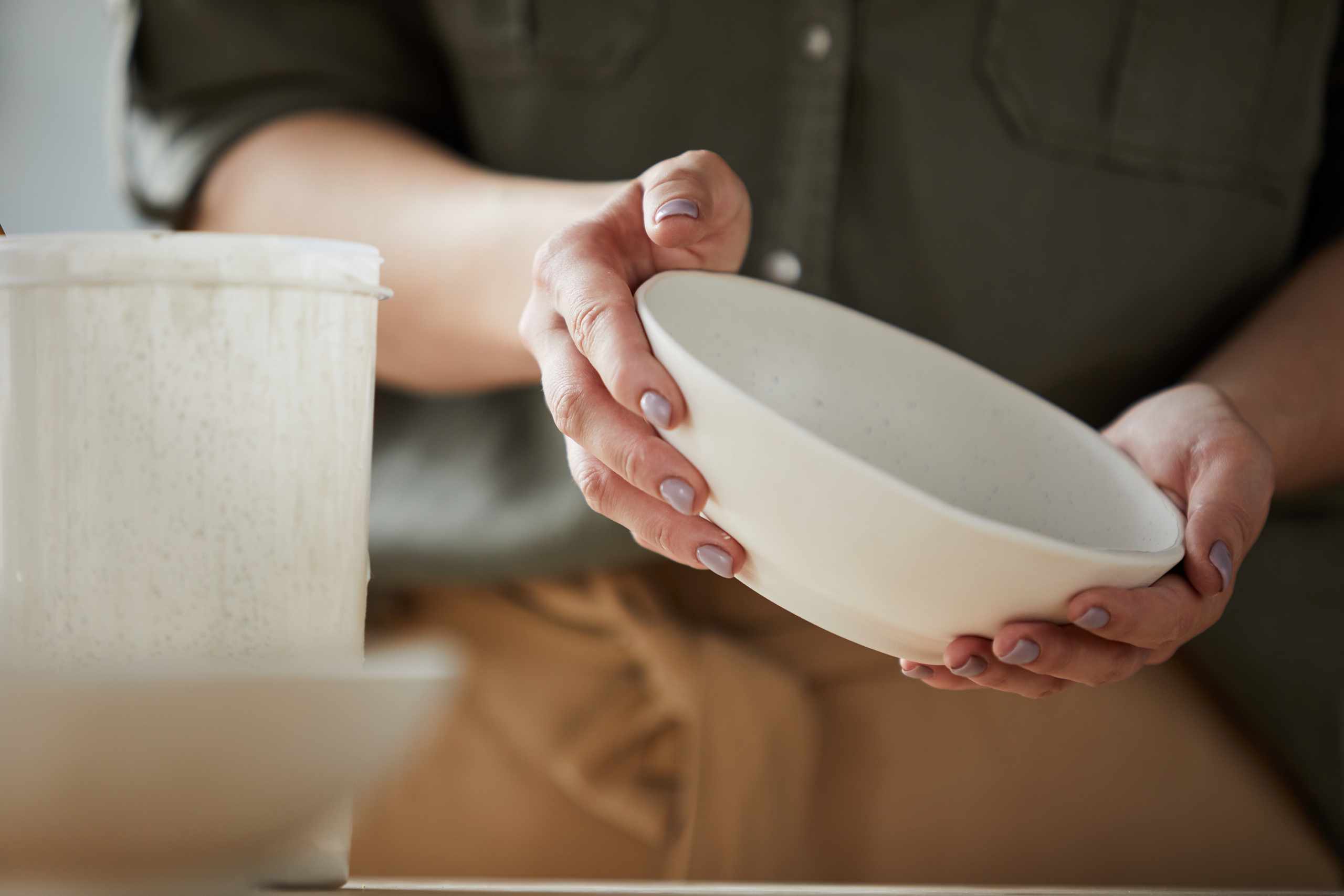
Check a newly made porcelain bowl. Run your fingers around the inside edge near the rim, then down the wall to where it meets the foot. Is the wall near the rim thinner than the wall near the base? Or vice versa? If one area is thicker, this will become an issue long before you fire the bowl. As the clay dries, the porcelain will shrink, and it will continue to shrink during firing. But if the walls of the bowl are not all the same thickness, they will not all shrink at the same rate.
Areas that are thicker will tend to retain moisture longer than areas that are thinner. The thin rim might start to dry while the thicker wall near the base is still wet. This will cause uneven shrinkage and could lead to a crooked rim, a pulled-in side, or a base that doesn’t sit flat. Drying faster increases the risk of uneven shrinkage because the moisture difference between the two sides of the bowl will grow faster.
The unevenness that causes this can begin during the forming process, not just during drying. You might press too hard in one spot, leave more clay at the bottom, or repeatedly use a sponge to remove clay on one side and not the other. These differences might not be visible when the porcelain is still wet. You can check the wall thickness at various places along the bowl with your fingers to catch these problems early. You can also use a flexible rib to compress and refine the wall instead of adding water.
Try this experiment: Make three small cylinders from the same batch of prepared porcelain clay. Keep the first one as uniform as possible, add a little more clay at the bottom of the second cylinder, and make the third cylinder a little thinner on one side. Dry them under the same covering, and when they are leather-hard, compare the rim line, the walls, and the way each base sits on the table. The purpose of this exercise is not to make nice bowls, but to understand how thickness affects the shape.
Some of the extra clay in the bottom of the second cylinder might be trimmed away later. However, if the porcelain is too soft, the pressure of the trimming tool can bend the wall. And if the porcelain gets too dry, it’s harder to trim clean and the bowl is more likely to break. You need to wait until the porcelain is at a point where it’s firm enough to withstand the pressure of trimming, but still wet enough for the trimming tool to cut through the clay without scraping a bone-dry surface. Usually that point is leather-hard.
Uniform wall thickness does not mean your porcelain piece will never warp. The drying speed, joins, clay preparation, forming pressure, glazing, and firing can all play a role in whether or not your porcelain will warp. But controlling wall thickness will eliminate one unknown factor. If you make several test pieces from the same clay, dry them together, and one looks noticeably better than the others after drying, then you’ll know your forming technique is improving.